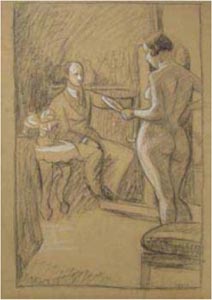
John Lyman, self-portrait
BIOGRAPHY
Lyman’s
drawing
often concentrated
on
the
foundations,
thus
precisely
documenting
the
preparatory
works
of
some
of
his
completed
oil
paintings.
The
precision
of
his
drawing
stems
from
his
love
of
architecture,
which
he
studied
in
1 908,
albeit
to
please
and
reassure
his
father.
The
influence
of
photography
can
also
be
seen
in
his
sketches.
In 1916,
Lyman
worked
with
photographers
for
his
contract
cataloguing,
with
illustrations,
the
architectural
patrimony
of
Bermuda.
His
charcoal
and
soft
pencil
sketches
illustrate
the
same
dynamic
tendency
to
render blocks
of
black,
white
and
grey
and
to
distribute
and
multiply
the
points
of
view,
variations
of
which
were
sometimes
quite
similar.
In
1910,
Lyman
describes
in
his
correspondence
the
emotion
he
felt
during
his
visit
to
Matisse’s
studio
in
Issy‐les‐Moulineaux. The
sensation
that
he
felt
induced
him
to
sign
up
for
Matisse’s
classes.
After
a
scandalous
first
exhibition
in
1913
at
the
Montreal
Musée
des
beaux‐arts,
Lyman
adopted
Paris
as
his
home
base.
He
joined
the
Red
Cross
during
the
Great
War,
following
his
training
with
the
Canadian
army.
In
Paris,
between
1913
and
1931,
he
called
friend
the
likes
of
James
Wilson
Morrice,
Orthon
Friesz,
Foujita,
Zadkine,
Matthias,
Picabia,
the
Perret
brothers
and
James
Joyce,
Jules
Romain,
Charles
Vildrac
and
Gertrude
Stein
amongst
the
writers.
His
return
to
Montreal
marked
the
beginnings
of
a
new
era
as
contrary
to
the
Group
of
Seven
Lyman
advocated
internationalism.
He
thus
declared
opposition
to
“the
regionalists
who
only
produced
banal
clichés”.
As
an
art
critic
and
director
of
exhibitions
at
the
head
of
the
Société
d’Art
Contemporain,
this
grand
agent
of
the modernist
ideas
of
the
École
de
Paris
attempted
to
“deprovincialize”
Quebec
and
Canadian
art.
Through
his
drawing
Lyman
found
and
chose
the
facets
to
highlight
in
his
painting.
Scrutinizer
or
intellect,
he
also
used
drawing
as
a
form
of
expression
in
its
own
right.
Rarely
dated,
his
sketches
sometimes
reuse
the
same
themes
or
subjects,
repeating
the
same
motifs
that
appeared
through
the
years
alongside
certain
pre‐painting
drawings,
annotated
occasionally
with
written
reminders
of
colours.
All
throughout
his
lifetime,
Lyman
thus
drew
on
ideas
and
solutions
for
the
way
in
which
to
portray
the
live
model
or
the
bathers
theme.
He
blends
the
same
pose
with
different
contexts,
using
some
of
his
discoveries
in
several
paintings,
sometimes
executed
at
an
interval
of
several
decades.
Drawing
for
him
was
a
means
to
explore
painting.
Similarly
to
Matisse’s
work,
Lyman’s
drawings
depicted
the
outlines
as
much
as
the
space
in
between.
The
disposition
made
use
of
the
four
sides
of
the
sheet
of
paper
with
the
volume
coming
to
the
forefront.
The
white
of
the
sheet
stands
out,
playing
an
active
role
in
th e
composition.
A
complex
relationship
exists
between
the
forms,
outlines
and
spaces.
This
equilibrium
emits
a
sense
of
calm
and
renewal.
Matisse and
Morrice?
Cezanne?
Maybe
Whistler?
Certain
critics
have
discerned
the
influence
of
these
artists
in
Lyman’s
drawings
and
paintings,
or
a
certain
similarity.
It
is
in
fact
demonstrating
the
connection
to
a
same
light,
a
common
spirit
or
way
of
thinking.
“A
painter
only
has
one
problem”,
writes
Lyman
in
1946,
“to
be
himself”.
SUBJECT / THEMES
It
has
been
said
that
Lyman
was
the
painter
of
intimacy.
Through
drawing,
John
Lyman
takes
us
on
a
journey
into
the
heart
of
this
“gentleman
painter’s”
attachment
to
the
visible
world
where,
as
in
front
of
the
Saint‐Jean‐de‐Luz
beaches
and
the
dunes
at
Cape
Cod,
he
was
able
to
be
completely
happy.
Contemporary
to
several
other
similar
drawings
previously
exhibited
and
dating
from
1921,
the
sketches
of
odalisques,
previously
unpublished,
evoke
the
long
sojourns
spent
by
the
Lyman
couple
in
Hammamet,
Tunisia,
as
of
1919.
This
theme
Lyman
would
revive
in
Paris
at
the
end
of
the
1920s.
All
throughout
that
decade
he
drew
sensual
females
in
the
nude,
striking
risqué
poses
and
an
unconventional
posture
of
a young
man,
thrusting
his
hips
to
the
side. Lyman
often
called
upon
athletes
or
fairground
entertainers
for
his
drawings
of
the
1920s.
This
bold
work
of
art
stands
out
through
the
artist’s
use
of
a
style
of
an alytical
cubism
typical
of
the
École
de
Paris
of
that
period.
Through
his
characteristic
use
of
pastel
and
pearly
colours,
both
very
brilliant
but
never
overly
intensified,
one
sketch
focuses
on
a
southern
landscape
of
the
aligned
trunks
of
a
pine
forest
in
Cagnes‐sur‐Mer.
It
was
here,
in
1922,
that
Lyman
bought
the
Villa
Blanca.
There,
as
in
the
West
Indies
and
Tunisia,
he
experienced
the
dazzling
light
of
the
South.
Also, The
sailing
boats
in
the
background
were
a
subject
matter
that
arose
several
times
in
both
sketches
and
paintings.
TECHNIQUE / MEDIUM
Only “half‐fauvist” however, as his work is “without the explosive tones”, as Gilles Corbeil writes. The drawings evoke both reserve and sensuality. Whilst celebrating a form of eroticism as a natural phenomenon, the bodies set themselves free.
Peppered
with
analytical
cubism
but
also
with
a
“classical”
approach,
linked
to
the
figurative
renewal
of
the
1930s,
here
showing
him
to
be
ahead
of
his
time,
Lyman’s
universe,
which
although
so
personal
also
bears
the
influence
of
the
hedonism
of
French
painting
between
the
World
Wars.
Timeless
landscapes
form
a
contrast
with
more
contemporary
landmarks
linked
to
the
effects
of
industrialisation
or
urbanisation.
Following
the
modernist
tenet,
Lyman
puts
emphasis
on
the
composition
elements,
so
regimented
in
his
work,
and
on
the
primacy
of
colour
and
the
pictorial
language
with
detriment
to
any
message
that
could
be
deemed
“literary”.
However,
without
openly
admitting
it,
Lyman
sought
to
translate
the
secrets
of
a
more
internal
reality
where
we
can
sense
a
little
of
what
he
perceived
to
be
his
existence
and
relationship
to
the
world.
In
this
sense,
his
art
is
not
without
a
subtext
and
an
element
of
aloofness.
“A
living
paradox”,
Lyman
remains
an
enigma
to
a
certain
extent.
EXHIBITIONS
“Sketches from 1910, 20 & 30”, Galerie Valentin, May 2012
BIBLIOGRAPHY
The art critics who have best interpreted his work have said this each in their own way: Paul Dumas; Gilles Corbeil; Guy Viau and event the Montreal painter Philip Surrey who wrote several articles about him, or nearer to us Normand Thériault; Louise Dompierre and Louise Déry.
From a text by René Viau for the Valentin Gallery


